Author
Math Country
Share
Author
Math Country
Share
Many children can multiply fractions by following a formula, yet they struggle when the same skill appears in a word problem. They may know what to do but not why they are doing it. As a result, they often forget the procedure or apply it incorrectly in unfamiliar situations.
The goal of teaching fractions should not be memorization alone. Children who understand the meaning of fractions can solve new problems, explain their thinking, and recognize when an answer makes sense.
This lesson introduces a step-by-step teaching approach that helps children discover how to find a fraction of a number through reasoning, visual models, and real-life examples before learning the standard multiplication rule.
Why Children Struggle with Fraction Multiplication
Many textbooks introduce the rule first:
Multiply the numerators. Multiply the denominators.
Although this rule works, it does not explain why it works.
Without understanding, children often:
- memorize procedures instead of reasoning;
- forget the rule after a few weeks;
- become confused by word problems;
- cannot tell whether an answer is reasonable.
Instead of starting with the rule, begin with situations children already understand.
Teaching Goal
By the end of the lesson, children should understand that:
- the denominator tells how many equal parts the whole is divided into;
- the numerator tells how many of those parts to take;
- finding a fraction of a number means finding part of the whole.
Once these ideas are clear, the multiplication rule becomes logical rather than something to memorize.
Step 1: Begin with Repeated Addition
Start with multiplying a fraction by a whole number.
Do not introduce any formulas.
Instead, ask children to use addition.
Example 1
Find:
1/5 × 4
Ask:
“Can you add one-fifth four times?”
1/5 + 1/5 + 1/5 + 1/5 = 4/5
Children quickly recognize that multiplication is simply repeated addition.
Example 2
Find:
2/7 × 3
Instead of using a rule:
2/7 + 2/7 + 2/7 = 6/7
After several examples, ask:
“What pattern do you notice?”
Many children discover the multiplication rule on their own.
Step 2: Help Children Notice What Happens
Ask students to compare the answer with the starting fraction.
Example
3 × 1/4 = 3/4
Ask:
- Is 3/4 greater or smaller than 1/4?
- Why?
Children notice:
Multiplying a fraction by a number greater than one makes the result larger.
This observation is much more powerful than simply memorizing a formula.
Step 3: Reverse the Order
Now use the commutative property.
Explain that:
3 × 1/4
and
1/4 × 3
have exactly the same answer.
Example
5 × 2/3 = 10/3
Ask:
- Is the answer larger or smaller than 5?
- Why?
Now children discover another important idea:
Multiplying a whole number by a proper fraction gives a smaller amount than the original whole number.
This becomes one of their most valuable estimation skills.
Two Big Ideas Every Child Should Understand
Before moving on, make sure children understand these concepts.
When multiplying by a number greater than 1
The answer becomes larger.
Examples:
- 8 × 2 = 16
- 3/5 × 4 = 12/5
When multiplying by a number less than 1
The answer becomes smaller.
Examples:
- 12 × 1/2 = 6
- 20 × 3/4 = 15
If children understand these ideas, they can often recognize impossible answers before finishing a calculation.
Step 4: Use Visual Models
Pictures help children connect fractions to real objects.
Pizza models work especially well because children naturally understand sharing.
One Pizza
Draw one pizza.
Ask:
Find 1/4 of the pizza.
Children divide the pizza into four equal slices and select one slice.
Two Pizzas
Draw two pizzas.
Ask:
Find 1/4 of both pizzas.
Children usually divide each pizza into four equal parts and take one slice from each.
They discover:
1/4 of 2 pizzas = 2/4 = 1/2 pizza
Five Pizzas
Instead of drawing five pizzas, draw one pizza and say:
“This picture represents five pizzas.”
Ask:
Find 2/5 of the pizzas.
Children begin thinking about the quantity rather than the drawing.
This transition from concrete models to abstract thinking is an important step in mathematical development.
Step 5: Connect Pictures to Mathematics
Once children understand the pictures, write matching expressions.
Example
Find:
2/3 of one pizza
Reasoning:
- Divide into 3 equal parts.
- Take 2 parts.
Expression:
1 ÷ 3 × 2
Now change the situation.
Find:
2/3 of 6 pizzas.
Reasoning:
Each pizza contributes 2/3.
Expression:
6 × 2/3
Because multiplication is commutative:
2/3 × 6
gives exactly the same result.
Children now understand why multiplying by a fraction finds part of a quantity.
Step 6: Move to Word Problems
Only after children understand the idea should you introduce word problems.
Example 1
Maria baked 18 cookies.
She gave 2/3 of them to her friends.
How many cookies did she give away?
Think:
- Divide 18 into 3 equal groups.
- Each group has 6 cookies.
- Take 2 groups.
Answer:
12 cookies
Example 2
A rope is 24 feet long.
Tom uses 3/8 of the rope.
How many feet does he use?
Think:
24 ÷ 8 = 3
3 × 3 = 9
Answer:
9 feet
Example 3
A class has 30 students.
Four-fifths of the students brought lunch.
How many students brought lunch?
30 ÷ 5 = 6
6 × 4 = 24
Answer:
24 students
Common Teaching Mistakes
Many children become confused because instruction moves too quickly.
Avoid these common mistakes.
Teaching the rule before the concept
Children memorize but rarely understand.
Skipping visual models
Pictures build conceptual understanding that symbols alone cannot provide.
Practicing only computation
Children should solve both numerical exercises and real-world word problems.
Ignoring estimation
Before calculating, ask:
“Should the answer be bigger or smaller?”
This simple question develops mathematical reasoning.
Signs That Children Truly Understand
A child has developed conceptual understanding when they can:
- explain why the denominator comes first;
- predict whether the answer will be larger or smaller;
- solve word problems without guessing;
- explain the process using pictures;
- teach another student how it works.
These skills show understanding rather than memorization.
Why Understanding Matters More Than Memorization
Students who understand the meaning of fractions become more confident problem solvers. Instead of relying on rules they may forget, they can reason through unfamiliar situations and decide whether an answer makes sense.
Conceptual understanding also prepares children for later topics such as ratios, proportions, percentages, algebra, and probability. A strong foundation in fractions supports success throughout mathematics.
Practice with Fraction Worksheets
After children understand the concept, regular practice helps build fluency.
Use a variety of activities, including:
- visual fraction models;
- finding fractions of whole numbers;
- multiplication practice;
- fraction word problems;
- real-life applications;
- mixed review exercises.
Practice should reinforce understanding—not replace it.
Well-designed fraction worksheets give children the opportunity to apply what they have learned while continuing to develop confidence and mathematical reasoning.
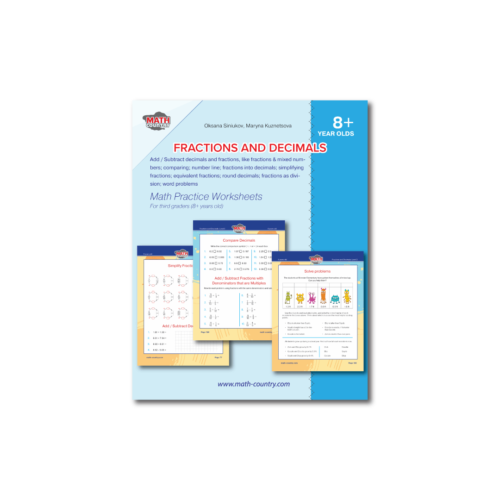
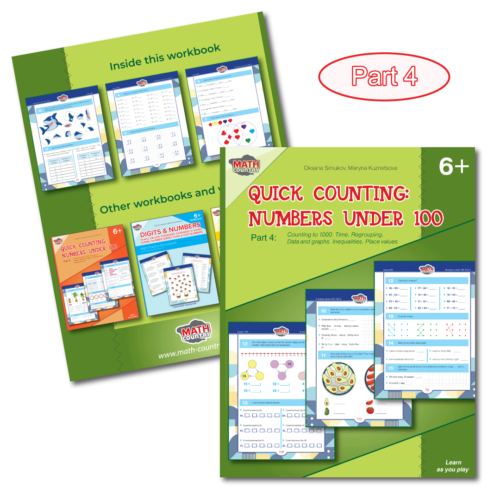
To help children fully understand and master Fractions topic, we specially designed our fraction worksheets grades 2-4. Parents and teachers can use these worksheets for practice fractions problems in class or at home.

Stay in the loop