2nd Grade Math Diagnostic Test: Find Skill Gaps
Find out which math skills your child understands and which need more practice. Our online second-grade math diagnostic assessments for ages 7+ help parents identify strengths and skill gaps.
View results online and download a personalized PDF report with skill-by-skill explanations and recommended practice materials.
Beginner and Intermediate are free. Advanced costs $5. Choose a diagnostic level below to find out what to practice next.


A total score is only the starting point. The Grade 2 diagnostic report breaks down performance by math topic so you can see where your child answered successfully and where more practice may help.
Use the explanations and recommended worksheets and workbooks to choose focused practice for the skills assessed.
A clearer picture of your child’s math skills
Know what to practice next
What your diagnostic report includes
- An overall assessment result and percentages by assessed skill area
- Explanations of the skills and what the answers suggest
- Areas of strength and skills that may need more practice
- Recommended worksheets and workbooks for targeted practice
Review the topic breakdown online. Choose DOWNLOAD REPORT to save or print the PDF, or IMPROVE to explore recommended materials.
The beginner and intermediate assessments are free. Recommended practice materials may be sold separately. Results describe performance on the skills assessed rather than every aspect of a child’s mathematical ability.
Choose a diagnostic level
Choose from three second-grade diagnostic assessments. Beginner and Intermediate are free; Advanced costs $5.
- Beginner diagnostic assessment: a starting point covering six areas, including arithmetic, geometry, measurement, and word problems.
- Intermediate diagnostic assessment: a more challenging assessment across seven areas, including fractions.
- Advanced: additional challenge for children ready to extend their learning.
If you are unsure where to start, choose Beginner and use the report to decide what to practice before moving on.

Math skills covered across the levels
Spatial relationship:
- 1Location in a grid
- 2Coordinate plane
- 3Equal parts
- 4Positions
- 5Patterns
- 6Ordering and classifying
Geometry:
- 1Two-dimensional shapes: sides, vertices, angles
- 2Perimeter
- 3Area
- 4Two-dimensional shapes
- 5Three-dimensional shapes
- 6Geometric measurements (Perimeter and Area of complex figures)
Number and operations:
- 1
Mental math
- 2Vertical addition and subtraction with regrouping (two-digit numbers)
- 3Even and odd numbers
- 4Place values and Rounding to the nearest 10, 100
- 5Mixed operations (addition, subtraction, multiplication)
Measurement, money, and data:
- 1Time on the analog clock
- 2Elapsed time
- 3Exchanging money
- 4Correct amount of change
- 5Units of length
- 6Units of weight
- 7Balancing the scales
Word problems
Operations and algebraic thinking:
- 1Comparing numbers and expressions
- 2Equations
- 3Inequalities
- 4Order of operations with parenthesis
- 5Multiplication
Fractions
- 1Add/subtract fractions with the same denominators
- 2Fraction of a set
- 3Equivalent fractions
Logic problems
Workbooks and worksheets
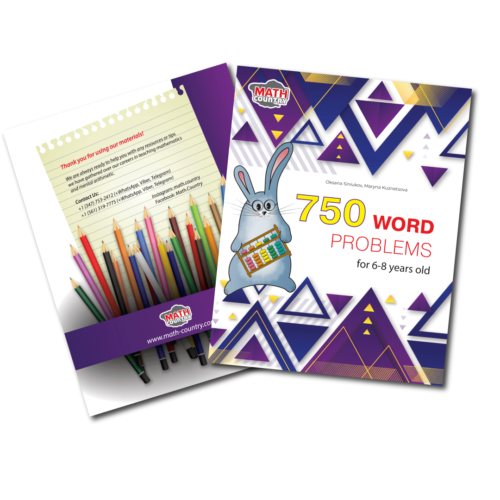
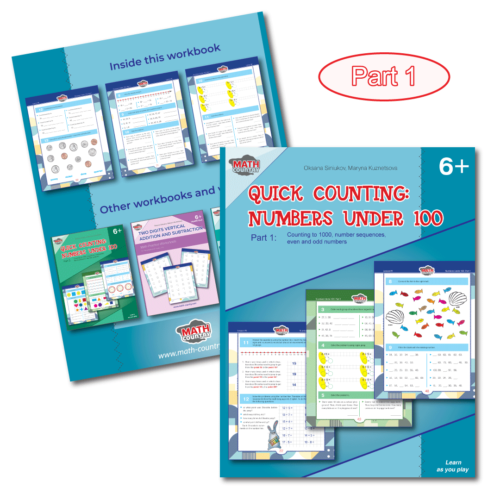
Use the recommendations in your child’s diagnostic report to choose suitable practice from the Entertaining Math workbook series and Grade 2 worksheets.
Encourage your child to answer independently. Help read instructions when needed without supplying the answers. After the test, follow the prompts for the child’s name and an email address to receive the report and recommendations.
A lower score suggests a topic to revisit; it does not define a child’s overall ability or potential.